



Intel Core Ultra 5 vs Core i5 Laptops: Key Differences in Performance, AI & Everyday Use
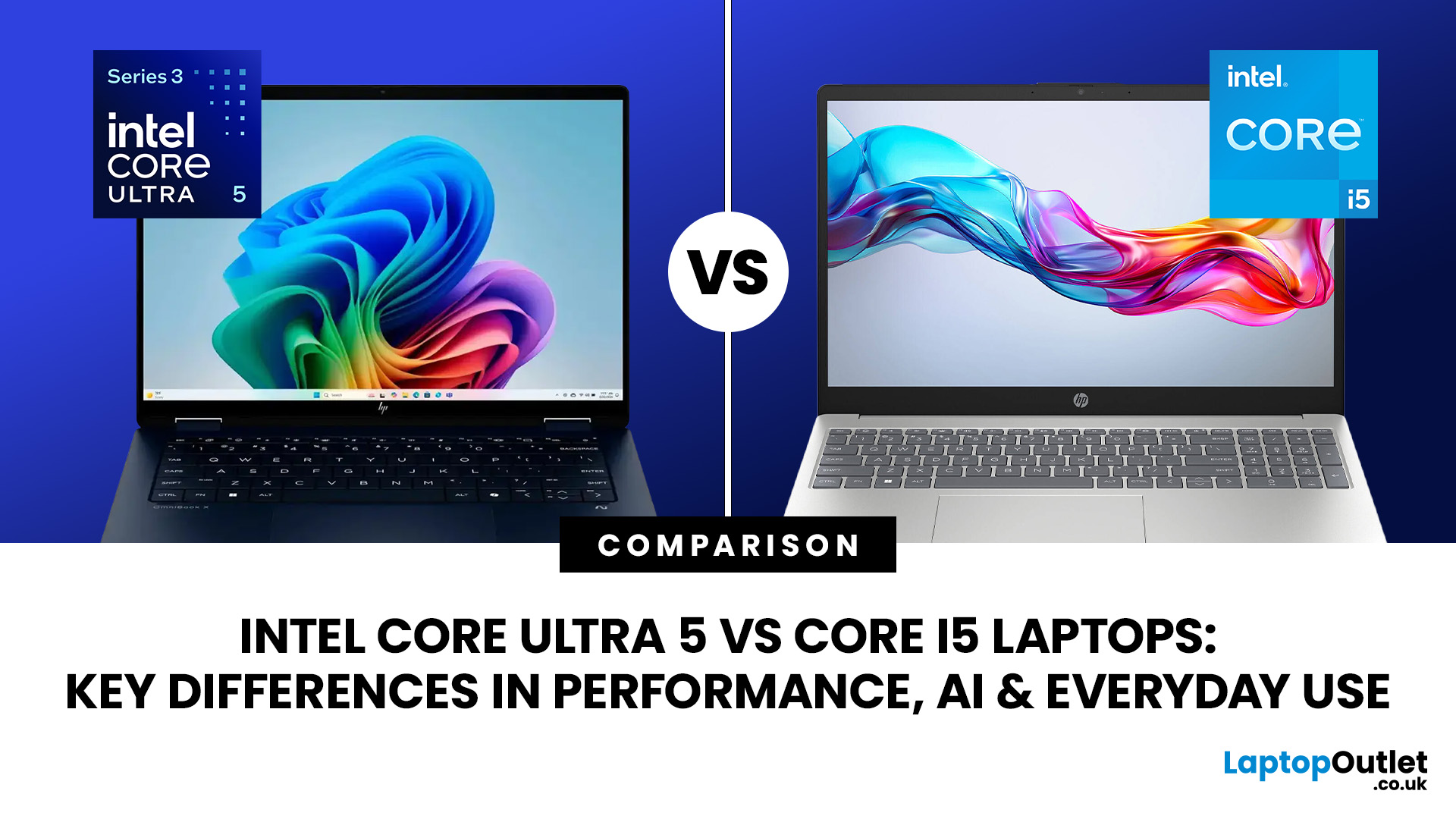
Intel has changed how it names and builds its laptop processors (CPUs). Traditional Core i5 chips remain widely available, but newer premium laptops increasingly use the Core Ultra 5 name, which Intel introduced alongside a major architectural redesign and built-in AI acceleration. That makes the Intel Core Ultra 5 vs i5 comparison more complicated than simply checking which number looks newer.
This guide explains the differences in everyday speed, multitasking, graphics, gaming, AI features, and battery life, without burying the answer under unnecessary technical jargon.
Quick Answer: Should You Buy Intel Core Ultra 5 or Core i5?
Buy Core Ultra 5 for stronger integrated graphics, on-device AI features and generally better efficiency. Buy Core i5 when price matters most, especially for office work or laptops with dedicated graphics card. Always compare the exact processor suffix and laptop configuration.
|
If you want... |
Buy |
Why |
|
Lowest price |
Core i5 |
Older i5 laptops are regularly discounted |
|
Better battery efficiency |
Core Ultra 5 |
Newer designs can handle background tasks more efficiently |
|
Built-in AI acceleration |
Core Ultra 5 |
Includes a dedicated NPU |
|
Everyday productivity |
Either |
Both are quick enough for browsing, Office and video calls |
|
More future-ready hardware |
Core Ultra 5 |
Newer AI, graphics and media capabilities |
|
Casual gaming without a dedicated GPU |
Core Ultra 5 |
Qualifying models use faster Intel Arc graphics |
|
Best value |
Core i5 |
Often provides similar basic CPU responsiveness for less |
As of July 2026, UK listings show 16GB and 512GB Core i5 laptops selling from roughly £459 to £599, while Core Ultra 5 models with similar memory and storage can start at around £630 and rise considerably with OLED screens or premium construction. Prices change regularly and should not be compared without matching the other specifications.
Intel Core Ultra 5 vs Core i5 at a Glance
The table below compares typical Core Ultra 5 laptops with the 12th, 13th and 14th-generation Core i5 machines that remain common in UK shops. Individual specifications vary significantly between U-series, H-series, HX-series and V-series processors.
|
Feature |
Intel Core Ultra 5 |
Intel Core i5 |
|
Architecture |
Newer Series 1, 2 or 3 platform, often using modular chip design |
Mainly older Alder Lake or Raptor Lake hybrid architecture |
|
CPU cores and threads |
Varies by model, such as 8 cores and 8 threads or 14 cores and 18 threads |
Varies by model, such as 8 cores and 12 threads or 12 cores and 16 threads |
|
Dedicated AI NPU |
Yes |
No on traditional Core i5 models |
|
Integrated graphics |
Intel Arc on qualifying models, otherwise Intel Graphics |
Intel Iris Xe eligible or Intel UHD |
|
Battery efficiency |
Generally better, particularly on V-series chips |
Can still be good, but depends heavily on the laptop |
|
Copilot+ eligibility |
Only qualifying models with a sufficiently powerful NPU |
No |
|
Casual gaming |
Usually stronger without a dedicated GPU |
Suitable for lighter or older games |
|
Multitasking |
Strong, with efficient background processing |
Strong, especially on higher-powered H-series chips |
|
Best users |
Travellers, creators, hybrid workers and AI-focused buyers |
Office users, home users and value-focused buyers |
|
Typical UK positioning |
Mid-range to premium |
Budget to mid-range |
The biggest Intel Core Ultra 5 vs i5 differences are the NPU, integrated graphics platform and potential efficiency gains. Raw CPU speed can be surprisingly close, and an older high-powered i5 can sometimes beat a low-powered Ultra 5.
What Is the Difference Between Intel Core Ultra 5 and Core i5?
Intel’s New Naming Explained
Intel previously used names such as Core i3, Core i5, Core i7 and Core i9 across most of its consumer processors. It removed the “i” from new processor tiers and created two families: mainstream Intel Core chips and premium Intel Core Ultra processors.
That means Core i5, Core 5 and Core Ultra 5 are not interchangeable names. Core i5 belongs to Intel’s earlier naming system, while Core Ultra identifies newer processors with expanded graphics, media and AI hardware.
New Architecture and Chip Design
Many Core Ultra processors use a tiled or multi-component design. Different parts of the processor can handle computing, graphics, input-output and low-power tasks more efficiently than relying on one traditional chip section.
The exact design varies by generation:
- Core Ultra Series 1: The original Meteor Lake family, including the Core Ultra 5 125H.
- Core Ultra Series 2 H: Arrow Lake processors such as the 225H, focused on stronger CPU and integrated graphics performance.
- Core Ultra Series 2 V: Lunar Lake chips such as the 226V, focused heavily on portability, battery efficiency and Copilot+ support.
- Core Ultra Series 3: The newest 2026 generation, including processors such as the Core Ultra 5 338H.
The Biggest Upgrade Is AI
Every Core Ultra generation includes an NPU, or neural processing unit. This makes a Core Ultra 5 an Intel AI processor capable of handling supported tasks without relying entirely on the CPU or integrated GPU.
However, not every Core Ultra 5 is a Copilot+ processor. The Core Ultra 5 125H has an 11-TOPS NPU, while the 225H provides 13 TOPS. The efficiency-focused 226V reaches 40 TOPS, and the newer 338H reaches 47 TOPS.
Improved Integrated Graphics
Arc-equipped Core Ultra 5 processors can deliver a substantial graphics improvement over the Intel UHD graphics used in many Core i5 laptops. This benefits games, video editing, effects, media encoding and applications that use GPU acceleration.
The improvement is not universal. Always check the exact graphics name because some lower-power Core Ultra chips have more basic Intel Graphics, while Arc branding and performance can also depend on the laptop maker’s memory configuration.
What Do the U, H, V and HX Processor Suffixes Mean?
The letters at the end of an Intel processor name indicate the type of laptop and workload the chip is designed for. They are especially important when making a Core Ultra vs Core i5 comparison because the performance tier alone does not reveal the processor’s power profile.
|
Processor suffix |
Main focus |
Common laptop type |
Best suited to |
|
U |
Power efficiency |
Browsing, Office, study, remote work and longer battery life |
|
|
H |
High mobile performance |
Performance, creator and mainstream gaming laptops |
Heavy multitasking, coding, content creation and casual gaming |
|
V |
Efficiency, integrated graphics and AI |
Premium ultraportable and Copilot+ laptops |
Travelling, on-device AI, media work and all-day mobile use |
|
HX |
Maximum laptop CPU performance |
Large gaming laptops and mobile workstations |
AAA gaming, rendering, engineering and demanding professional software |
Performance Comparison: Is Core Ultra 5 Actually Faster?
The answer depends on the two exact processor models being compared. A Core Ultra 5 is not automatically faster than every Core i5, particularly in sustained CPU-heavy work.
For a more meaningful Core Ultra 5 vs i5 performance comparison, it helps to compare processors from similar laptop classes. The Core Ultra 5 125H and Core i5-13500H are useful examples because both appear in performance-focused mainstream laptops.
Everyday Performance
For Word, Excel, web browsing, streaming, email and video calls, both processors are fast enough. The difference between them may be difficult to notice when both laptops have 16GB RAM and a responsive NVMe SSD.
A slow SSD, an overloaded Windows installation or only 8GB RAM is more likely to make a laptop feel sluggish than a small difference in processor benchmark scores.
Multitasking
Core Ultra 5 tends to manage mixed workloads efficiently because background processes can be distributed across performance, efficiency and low-power cores. It is well suited to users who keep many browser tabs, communication apps and Office documents open simultaneously.
Core i5 H-series processors can also be extremely capable. Some maintain higher sustained CPU performance when installed in larger laptops with more generous power limits and cooling.
Creative Work
Core Ultra 5 has an advantage in workloads that use its Arc graphics, media engine or NPU. This can include accelerated photo effects, video playback, supported video exports and compatible AI tools.
Traditional CPU rendering may still favour a higher-wattage Core i5 H-series processor. For serious 4K editing, animation or 3D work, dedicated graphics and 32GB RAM are generally more important than choosing between these two processor families.
Coding and Development
Both platforms are suitable for web development, programming, local databases and moderate code compilation. Core i5 H-series models can remain competitive in sustained compilation, while Core Ultra 5 may provide better efficiency during mixed development workloads.
Developers using containers, virtual machines, Android emulators or large integrated development environments should prioritise 32GB RAM. Memory capacity is often the limiting factor before the processor becomes a problem.
Gaming Performance
Without a dedicated GPU, Core Ultra 5 usually wins. Its Arc integrated graphics can provide a substantial improvement over Iris Xe, particularly in games that support modern DirectX features or Intel XeSS upscaling.
With a dedicated GPU, the comparison changes. An i5 laptop that includes an RTX-series GPU may deliver much higher gaming performance than a slim Ultra 5 model relying on integrated graphics.
Intel Core Ultra 5 vs i5 Benchmark Comparison
No single benchmark can represent every Core Ultra 5 or Core i5 laptop. Performance varies according to the exact processor, laptop cooling system, memory configuration, manufacturer power limits and operating mode.
This comparison uses the Core Ultra 5 125H and Core i5-13500H, two widely compared H-class processors designed for performance-focused mainstream laptops. The results provide a useful indication of their relative CPU and integrated graphics capabilities, but they should not be treated as guaranteed performance for every laptop.
CPU Benchmark Results
|
Benchmark |
Core Ultra 5 125H |
Core i5-13500H |
Result |
|
Geekbench 6 single-core |
2,256 |
2,351 |
Core i5 approximately 4% faster |
|
Geekbench 6 multi-core |
10,239 |
11,050 |
Core i5 approximately 8% faster |
|
Cinebench 2024 single-core |
100 |
103 |
Core i5 approximately 3% faster |
|
Cinebench 2024 multi-core |
847 |
818 |
Core Ultra 5 approximately 4% faster |
|
Cinebench R23 multi-core |
14,771 |
15,116 |
Core i5 approximately 2% faster |
|
PassMark CPU Mark |
20,140 |
20,918 |
Core i5 approximately 4% faster |
Sources: CPU Monkey Intel processor comparison and PassMark CPU comparison. PassMark’s figures were based on 3,856 submitted results and were current at the time of writing.
Integrated Graphics Benchmarks
The larger difference appears in graphics performance. A qualifying Core Ultra 5 125H system can use a 7-core Intel Arc iGPU, whereas the Core i5-13500H commonly uses Iris Xe Graphics with 80 execution units.
|
Graphics measurement |
Arc 7-core iGPU |
Iris Xe 80 EU |
Difference |
|
Geekbench 6 OpenCL |
27,187 |
14,240 |
Arc approximately 91% faster |
|
Theoretical FP32 performance |
3.9 TFLOPS |
Up to 1.9 TFLOPS |
Arc approximately 2.1 times higher |
Source: NanoReview Arc 7-core vs Iris Xe 80 EU comparison. These are graphics-compute results, not guarantees of identical gaming gains.
What the Results Mean
Conventional CPU performance is close, with the Core i5-13500H holding small leads in most tests and the Core Ultra 5 125H winning Cinebench 2024 multi-core. Most users will notice little difference in everyday productivity.
The Core Ultra 5 has the clearer advantage for integrated-graphics gaming, media work and GPU-accelerated applications. Intel notes that Arc branding on H-series laptops requires at least 16GB of dual-channel memory and manufacturer enablement, so buyers should verify the complete laptop specification.
AI Features: Why Core Ultra 5 Is Different
What Is an NPU?
A neural processing unit, or NPU, is a specialised processor for neural-network workloads. Instead of using the general-purpose CPU for every camera effect, transcription model or image-processing task, supported software can send that work to the NPU.
This can reduce CPU and GPU use, improve responsiveness and use less power during sustained AI activity. Core Ultra combines CPU, GPU and NPU engines so software can choose the most suitable hardware for each workload.
AI Features You Can Actually Use
Depending on the laptop, Windows version, NPU performance, application and region, useful features may include:
- Windows Studio Effects: Automatic framing, eye-contact correction, portrait lighting, background blur and voice focus during supported calls.
- Live Captions: Automatic captions for audio playing through Windows, with offline operation and translation capabilities on compatible Copilot+ PCs.
- Background blur: NPU-assisted separation of the user from their surroundings during video calls.
- AI noise removal: Filters background sounds while reducing the load placed on the CPU.
- Copilot: Helps with drafting, summarising, questions and image generation, although many Copilot functions still use online services.
- Image generation and editing: Compatible Copilot+ PCs can run supported creation, removal or transformation models locally.
- On-device AI: Certain models can process camera, audio, search or image data without repeatedly sending it to a cloud server.
A crucial distinction is that not every Core Ultra laptop is a Copilot+ PC. Microsoft defines Copilot+ PCs as Windows 11 devices with:
- A compatible processor or system-on-chip
- A 40+ TOPS NPU
- 16GB DDR5 or LPDDR5 memory
- 256GB SSD or UFS storage
Buyers specifically seeking these experiences should compare the latest AI-enabled laptops and confirm that the product is labelled as a Copilot+ PC. “AI ready” and “Copilot+” do not always mean the same thing.
Do You Really Need AI in 2026?
Most buyers do not need an NPU to write documents, browse the internet or stream video. A traditional i5 remains perfectly capable of running cloud-based Copilot, ChatGPT and other online AI services.
An NPU becomes more useful for frequent video calls, local transcription, accessibility tools, creative AI applications and software that continuously applies background effects. Its value should improve as more Windows applications add proper NPU support
Battery Life and Power Efficiency
Why Core Ultra 5 Can Use Less Power
Core Ultra processors were designed to distribute work across the CPU, GPU and NPU more efficiently. Some models also include low-power cores that can manage simple background tasks without activating the faster, more power-hungry sections.
This does not mean every Core Ultra 5 laptop will last longer than every Core i5 machine. Display type, brightness, battery capacity, wireless activity, cooling and manufacturer tuning can change runtime considerably.
Which Processor Lasts Longer?
A Core Ultra 5 laptop will often last longer than a similarly sized Core i5 model, but the processor is only one part of the calculation.
|
Factor |
Effect on battery life |
|
Processor generation |
Newer Ultra designs can be more efficient |
|
Processor suffix |
U-series and V-series normally prioritise efficiency |
|
Battery capacity |
A 70Wh battery generally has more potential than a 40Wh battery |
|
Display |
OLED, 4K and high-refresh panels can use more power |
|
Brightness |
High brightness can shorten runtime significantly |
|
Dedicated GPU |
Can increase idle and active power use |
|
Manufacturer tuning |
Quiet, balanced and performance modes behave differently |
|
Workload |
Gaming and rendering drain a battery much faster than documents |
Heat and Fan Noise
An efficient processor may allow the fan to remain quieter during browsing, note-taking and video playback. It does not guarantee silence under sustained rendering, compilation or gaming.
A thin premium Ultra 5 laptop may also run warmer than a thicker i5 laptop with a larger cooling system. Chassis design, fan profile and surface ventilation must be considered alongside the processor.
Which Is Better for Travelling?
Frequent travellers should prioritise low-power Core Ultra 5 V-series and suitable Series 3 laptops, a 50Wh or larger battery, USB-C charging and a weight below roughly 1.5kg.
For occasional travel, a lightweight i5 laptop for work can remain a practical choice if it has an efficient processor, sensible display and enough battery capacity.
Graphics Comparison: Intel Arc vs Intel Iris Xe
Casual Gaming
Intel Arc is the clear winner when neither laptop has a dedicated graphics card. Esports games such as Valorant and Counter-Strike 2 can run at useful frame rates, while Fortnite may be playable at reduced settings.
Demanding games still require compromise. Cyberpunk 2077 may need low settings, resolution scaling and XeSS to remain playable, while newer AAA releases may exceed the practical limits of integrated graphics.
Creative Work
Arc graphics can improve supported photo filters, video previews, encoding and GPU-assisted exports. Its newer media engine is particularly useful for modern video formats.
For regular 4K editing, complex effects, Blender, CAD or professional 3D work, choose a laptop with dedicated NVIDIA or AMD graphics. The powerful laptops for gaming can also provide suitable options for GPU-heavy creative software.
Media and Streaming
Both graphics platforms can stream high-resolution video efficiently. Arc offers the newer media feature set and stronger support for modern codecs, which is useful when playing or creating AV1 content.
The display still determines picture quality. An Iris Xe laptop with an accurate OLED screen can provide a better viewing experience than an Arc laptop with a dim, low-colour LCD panel.
External Monitor Support
The maximum number, resolution and refresh rate of external screens depends on the processor, laptop ports and manufacturer wiring.
Do not assume that a processor capable of DisplayPort 2.1 automatically gives the laptop a DisplayPort 2.1 socket. Check whether USB-C supports DisplayPort Alt Mode or Thunderbolt, and confirm the manufacturer’s stated display limits.
Feature Comparison
|
Graphics feature |
Intel Arc integrated graphics |
Intel Iris Xe |
|
Typical processor family |
Qualifying Core Ultra models |
Selected Core i5 models |
|
Architecture |
Newer Xe LPG, Xe2 or Xe3 generation, depending on processor |
Older Xe LP generation |
|
DirectX support |
DirectX 12 Ultimate on relevant Arc configurations |
DirectX 12 |
|
Hardware ray tracing |
Available |
Not available in the same form |
|
Intel XeSS upscaling |
Better-supported modern platform |
More limited |
|
AV1 hardware encoding |
Available on relevant Arc generations |
Generally AV1 decoding rather than full modern encode support |
|
Casual gaming |
Stronger |
Suitable for lighter games |
|
Creative acceleration |
Better for supported modern applications |
Adequate for basic editing |
|
Memory requirement |
Arc branding may require 16GB dual-channel RAM on H-series |
Iris Xe branding also depends on qualifying memory configuration |
So, Which Integrated Graphics Are Better?
Intel Arc is substantially better than Iris Xe for casual gaming, GPU-assisted creative work and modern media features. Just confirm that the exact Core Ultra 5 laptop genuinely includes Arc graphics rather than basic Intel Graphics.
Buying Guide: What Else Matters Besides the Processor?
1. RAM
- 8GB: Suitable only for basic use and light multitasking.
- 16GB: The recommended baseline for most buyers in 2026.
- 32GB: Better for development, large spreadsheets, creative software and virtual machines.
- Dual-channel memory: Can be important for achieving full integrated-graphics performance.
- Soldered memory: Check carefully because many slim laptops cannot be upgraded.
2. Storage
A 512GB NVMe SSD is a sensible minimum for a general-purpose Windows laptop. A 256GB drive can fill quickly after Windows, applications, updates and personal files are added.
Choose 1TB for large photo libraries, video projects or installed games. Also check whether a second SSD can be installed later.
3. Display
Do not sacrifice display quality for a small CPU upgrade. Check:
- Resolution, ideally at least 1920 x 1080 or 1920 x 1200.
- Brightness, particularly for use near windows or outdoors.
- Colour coverage for photo and video work.
- Refresh rate for gaming and smoother scrolling.
- OLED burn-in considerations for static professional interfaces.
- Touchscreen and stylus support where required.
4. Graphics
Integrated Arc graphics are useful for portability and light gaming. Dedicated graphics remain the better choice for demanding games, 3D applications, advanced video work and AI models designed for a GPU.
5. Battery Capacity
Compare battery capacity in watt-hours where possible. Manufacturer runtime claims may use low brightness, offline video playback and power-saving modes that do not represent a full working day.
6. Ports and Connectivity
Look for the ports your setup actually requires:
- USB-A for existing accessories.
- USB-C charging.
- DisplayPort over USB-C.
- Thunderbolt 4 or Thunderbolt 5 where needed.
- HDMI for monitors and projectors.
- SD or microSD for photography.
- Wi-Fi 6E or Wi-Fi 7.
- A headphone socket if you use wired audio.
7. Build Quality and Weight
A metal chassis is not automatically more durable, and a plastic laptop is not automatically poor quality. Check keyboard flex, hinge stability, repairability, charger size and warranty coverage.
Those comparing budget laptops for students or everyday use should also account for the cost of a protective sleeve, USB-C charger and any required storage upgrade.
|
Do Not Overlook These Specifications
|

Intel Core Ultra 5 or i5: Which Should You Buy?
The Intel Core Ultra 5 vs i5 decision is less about one label being universally faster and more about priorities.
|
Buyer |
Recommendation |
Why |
|
Students |
Core Ultra 5 if affordable |
Better efficiency and graphics, but i5 remains suitable for basic coursework |
|
Office users |
Either |
Both handle documents, spreadsheets and meetings comfortably |
|
Home users |
Core i5 for value |
Usually enough for browsing, streaming and household admin |
|
Content creators |
Core Ultra 5 |
Better integrated graphics and media capabilities |
|
Casual gamers |
Core Ultra 5 |
Intel Arc is stronger than Iris Xe |
|
Frequent travellers |
Core Ultra 5 |
Newer efficient models generally suit mobile use |
|
Budget buyers |
Core i5 |
Discounted models can provide excellent everyday performance |
|
Copilot+ buyers |
Qualifying Core Ultra 5 only |
Verify the NPU rating and official certification |
After comparing your needs, look at top Intel Ultra 5 laptops for premium efficiency and AI support, or consider affordable Intel i5 laptops for straightforward performance and stronger value.

A Few More Things to Know...
Is Intel Core Ultra 5 better than Intel Core i5?
Core Ultra 5 is usually better for integrated graphics, efficiency and supported AI features. Core i5 can offer equal everyday speed and stronger value in discounted laptops.
Does Intel Core Ultra 5 improve gaming performance?
Core Ultra 5 can improve gaming when both laptops rely on integrated graphics. With the same dedicated NVIDIA or AMD GPU, cooling and power limits matter more.
Which is better for students: Intel Core Ultra 5 or Core i5?
Students wanting longer battery life, stronger integrated graphics and newer AI support should favour Core Ultra 5. Core i5 remains sensible for coursework on a tighter budget.
Which processor offers better battery life: Core Ultra 5 or Core i5?
Core Ultra 5 laptops typically last longer, especially efficient V-series models, but battery capacity, display type, software and manufacturer power settings can outweigh the processor difference.
Does every Intel Core Ultra 5 laptop support Copilot+ features?
No. Some Core Ultra 5 processors include an NPU below Microsoft’s Copilot+ threshold. Check for at least 40 TOPS and official Copilot+ PC certification before buying.
Related Articles


Last Updated: February 03, 2026
Choosing a new processor used to be a simple choice between raw power and budget value. However, as we move through 2026, the landscape has shifted.
The rivalry of Intel vs AMD desktop processors has reached a fever pitch, with both "Team Blue" and "Team Red" offering incredible technology that caters to very specific types of users.
This guide breaks down everything you need to know about the current market to help you decide which brand deserves a spot in your desktop PC.
The State of the Market in 2026
As we move through 2026, both manufacturers have moved beyond simple core-count wars.
Intel has doubled down on its "Arrow Lake" and "Nova Lake" architectures, focusing heavily on integrated AI NPUs (Neural Processing Units) and a refined tiled architecture.
Meanwhile, AMD continues to dominate the enthusiast market with its Zen 5 architecture, led by the legendary 3D V-Cache technology.
Intel’s Current Strategy: The AI PC Era
Intel has successfully transitioned to its LGA 1851 socket.
Last Updated: August 25, 2026
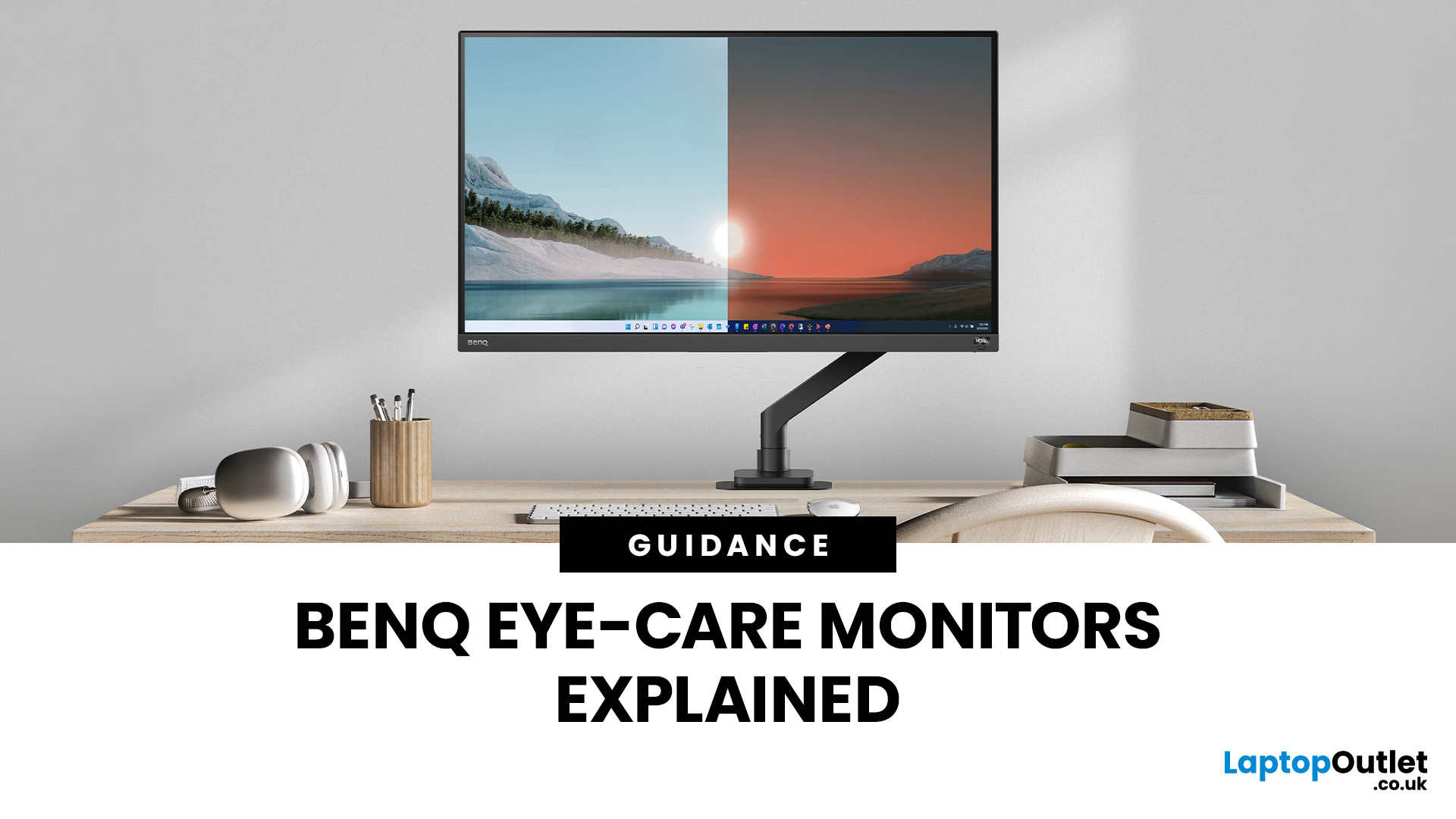
If you spend hours a day on a screen, you’ve probably felt it: tired eyes, headaches, dryness or that slightly gritty end-of-day sensation. While no monitor can solve every cause of screen-related discomfort, BenQ Eye-Care monitors include features designed to make longer sessions more comfortable by managing brightness, reducing flicker and giving you control over blue-heavy light, particularly for evening use.
What BenQ Eye-Care Means: Features and What They’re For
Several BenQ monitor ranges include comfort-focused tools under the Eye-Care umbrella. The exact feature set varies by model, but the typical options include:
- BenQ Brightness Intelligence, sometimes called Brightness Intelligence Plus or B.I.+, to adjust the screen according to your surroundings and displayed content
- Visual Optimizer, the newer name for B.I.+ on supported BenQ monitors, which can adapt brightness and colour temperature
- BenQ Low Blue Light or Low Blue Light Plus modes to reduce blue-heavy light output
- BenQ
Last Updated: April 07, 2026
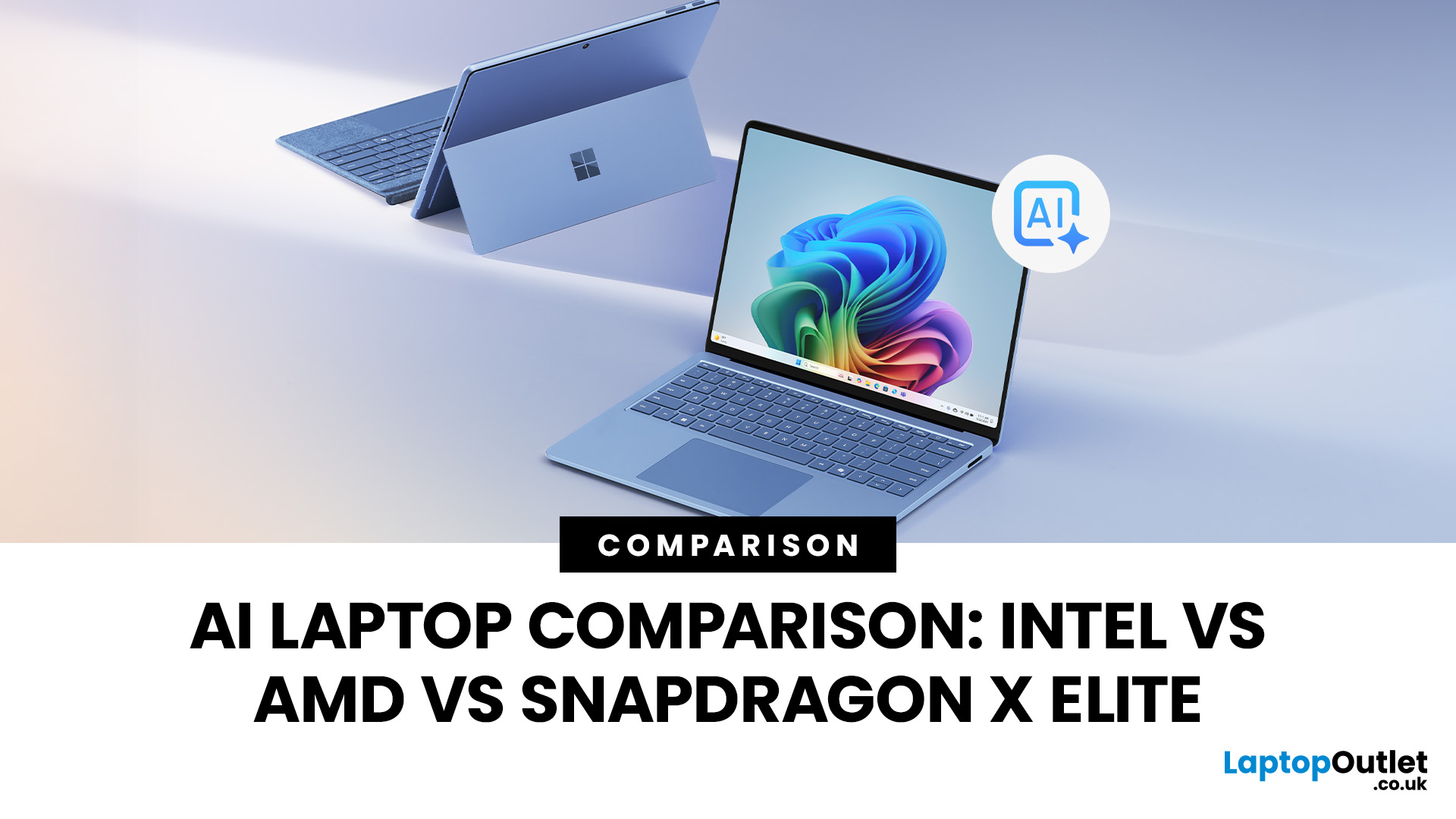
Buying an AI laptop in 2026 should be a quick decision. You pick a size, set a budget, and choose the “best” chip, right? In reality, the AI label is doing far too much work. Two laptops can sit side by side, both advertised as “AI-powered”, yet behave completely differently once you start writing documents, editing photos, joining video calls, or trying the latest Windows features.
That confusion usually comes down to one thing: people treat “AI laptop” as a single spec, when it’s really a mix of three engines working together.
- CPU: the general performance engine for everything you already do
- GPU: the visual and creative engine, also used for some AI workloads
- NPU: the efficiency engine for AI tasks that are built to run locally
This guide compares the 3 platforms shoppers are most likely to cross-shop when searching for an AI laptop today: Intel Core Ultra 200V (Lunar Lake), AMD Ryzen AI 300 (XDNA 2), and Qualcomm Snapdragon X Elite. We’ll keep it practical, explain the specs, and help
Last Updated: April 22, 2026
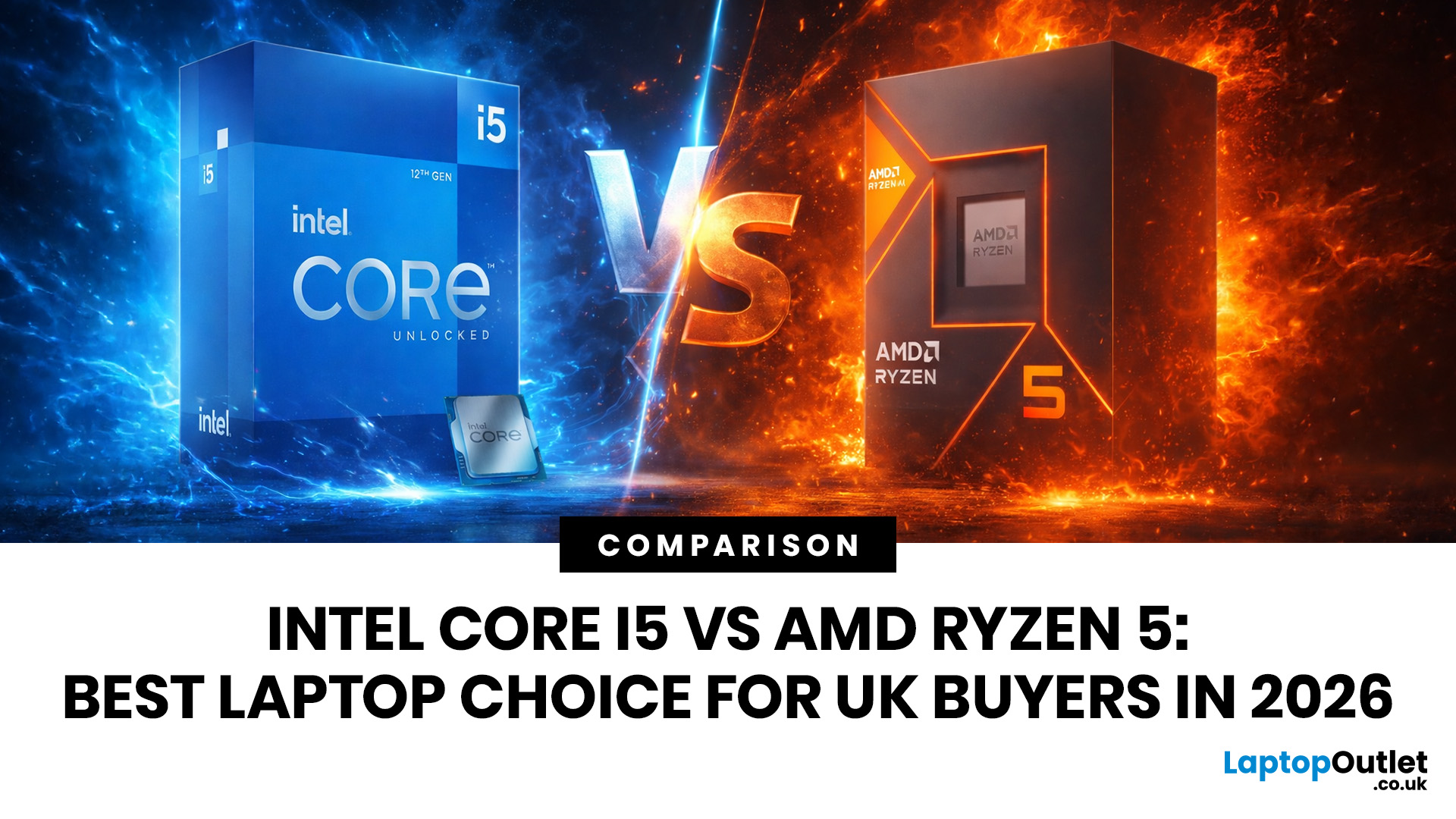
Choosing between Intel and AMD is no longer a simple case of picking the “faster” processor. If you are comparing Intel Core i5 vs Ryzen 5, you are looking at two highly capable mid-range options that power a large share of laptops available in the UK today.
Both deliver strong everyday performance, but they are designed with slightly different priorities. Understanding those differences is what helps you avoid overspending or buying a laptop that does not quite suit how you use it. This guide focuses on real-world use, not just specs, so you can make a confident decision in 2026.
Core i5 vs Ryzen 5: What is the Real Difference?
At a surface level, both processors handle everyday tasks comfortably. The difference comes from how they manage performance behind the scenes.
Intel’s modern Core i5 processors use a hybrid architecture that splits workloads between performance cores and efficiency cores. This allows the system to stay responsive even when multiple processes are running in the
Last Updated: June 10, 2026
Apple's WWDC26 keynote took place on Monday 8 June 2026 at 10am PT (6pm BST), running through to 12 June. The keynote delivered iOS 27, iPadOS 27, macOS Golden Gate 27, watchOS 27, tvOS 27, and visionOS 27, along with the long-awaited overhaul of Siri, now officially called Siri AI, powered by Apple Foundation Models developed in collaboration with Google's Gemini technology.
There were no major hardware announcements. It also marked a historic moment: the final WWDC keynote delivered by Tim Cook as Apple's chief executive.
What Is WWDC26 and When Did It Start?
WWDC stands for Worldwide Developers Conference, and it is Apple's flagship annual event where the company sets out its software roadmap for the year. This year marked the 37th edition, and it was once again a hybrid affair.
| Keynote Date 8 June 2026 | Keynote Time 10am PT | Conference End 12 June 2026 | Format Hybrid |
How Can You Watch the WWDC26 Keynote From the UK?
The keynote streams for free
Last Updated: July 09, 2026
Choosing a laptop CPU should not feel like decoding a boss fight.
You open five tabs, see terms like Core Ultra, Ryzen AI, Core i7, Ryzen 7, NPU TOPS, HX, U-series, integrated graphics, and suddenly the simple question - AMD or Intel for laptop? - becomes way more stressful than it should be.
This guide breaks down the Intel vs AMD laptop 2026 debate in plain English. You will learn how AMD Ryzen vs Intel laptop performance compares, which processor types in laptops actually matter, when Intel is the smarter buy, when Ryzen gives better value, and which in-stock Laptop Outlet models are
Last Updated: June 16, 2026
Intel Core i5, i7 and i9 processors all serve different types of laptop users. The right one depends on your daily workload, budget, battery expectations and the laptop’s overall build, not just the number printed on the processor badge.
For most people, Intel Core i5 is the sensible option. It handles study, office work, browsing, streaming, video calls and everyday multitasking without pushing the price too high. Intel Core i7 gives your laptop more breathing room. It suits people who work with heavier apps, play modern games, edit photos or videos, code, or keep lots of tasks open at the same time. Intel Core i9 sits at the top end. It is built for demanding users who need serious speed for 4K editing, 3D rendering, engineering software, large creative projects and premium gaming laptops with strong cooling.
The real answer is not always “i9 is best”. A newer i5 can outperform an older i7. A well-cooled i7 laptop can feel faster than a slim i9 laptop that overheats under pressure. This
Last Updated: July 03, 2026
Last Updated: September 03, 2026
AI is no longer limited to the cloud or research labs. It’s now built into everyday laptops, powering features like clearer video calls, live captions, and smarter editing tools. At the heart of this is the intel core ultra 5 NPU, a dedicated AI engine within the processor that handles machine-learning tasks efficiently. An intel core ultra 5 processor combines CPU, GPU, and NPU, allowing each task to run on the most suitable hardware. This setup improves multitasking and efficiency, though benefits depend on software support and the specific processor model.
What is Intel AI Boost NPU in Core Ultra 5 Laptops?
Intel AI Boost is the name Intel uses for the neural processing hardware integrated into supported Core Ultra processors. It is designed to process AI inference workloads efficiently, particularly tasks that run continuously or repeatedly in the background.
The AI boost NPU complements the CPU and GPU rather than replacing them. It becomes a low-power engine for longer-running AI
Last Updated: August 06, 2026

